04
20 Years of Harbourfront Development
"The Victoria Harbourfront Photo and Short Video Competition" Open Group · Photo · Camera - Merit | by PANG Kwong-on
Kennedy Town and Sai Ying Pun
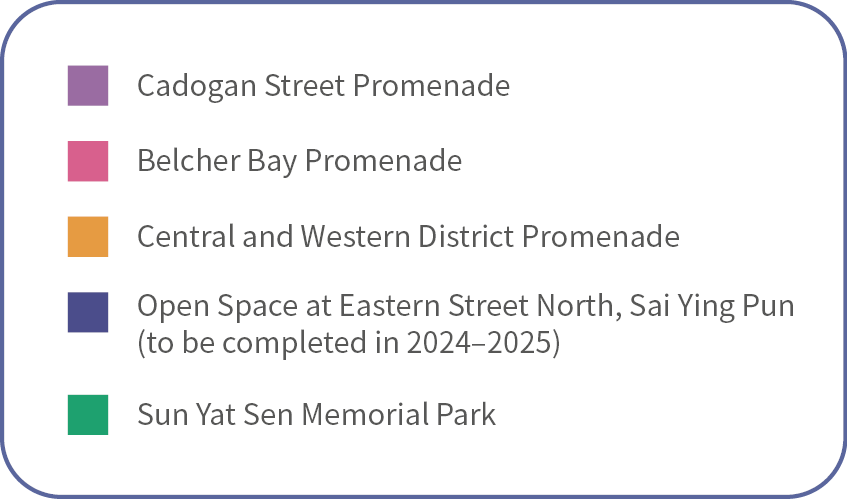
The development of the harbourfront in the Central and Western District has been achieved through various new initiatives. For instance, the Central and Western District Promenade (Western Wholesale Food Market Section) benefited from the release of waterfront land by the wholesale market, allowing its transformation alongside the revitalisation of four unused piers. Opened to the public in 2018, this project marked a significant step in connecting the harbourfront. Another example is the Belcher Bay Promenade in Kennedy Town, the first promenade opened under the “incremental approach” of the Harbourfront Commission. This project also reflects the Commission’s goals, including the effective use of idle waterfront land, the introduction of diverse harbourfront experiences, and the adoption of open space management.
Breaking Traditions with Audacious Attempts to Create of a Unique Waterfront Promenade
Formerly a public cargo working area, the Belcher Bay Promenade underwent construction starting in the latter half of 2018. According to the traditional arrangement of general projects, the harbourfront would only be opened to the public until the full 21-month construction period was completed. However, to meet the expectations of local residents and the District Council’s request for early access, the project team opened the approximately five-metre-wide section along the waterfront in early 2019, enabling public enjoyment 19 months ahead of schedule. The entire promenade was officially opened in October 2020.
The Belcher Bay Promenade was the first to implement the “Harbourfront Shared Space”open management model. It featured movable seating, recreational facilities, and pop-up art installations, encouraging public enjoyment of the space with mutual respect. The promenade’s stunning coastal views quickly made it a popular leisure spot for local residents and even attracted visitors from other districts to capture the sunset’s beauty blending sea and sky. Another notable feature is its pet-friendly policy, allowing visitors to bring leashed pets and offering a dedicated “Pet Corner” where pets can roam freely. Adopting the “unique features in every promenade section” approach to harbourfront development, the promenade also includes an open community garden operated by NGOs. The versatile space has hosted themed markets, urban farming experience workshops, and various events, supporting local businesses and creative industries.
New Harbourfront Design and Management Welcome by the Public
Harbour Office under Development Bureau
The “Harbourfront Shared Space” open management mode was first implemented on the Belcher Bay Promenade in Kennedy Town on a pilot basis. Is this management mode acceptable to the general public? To gauge public opinions, the Harbour Office under the Development Bureau commissioned a relevant professional body to conduct a study and consultation on the site’s new design and management mode in 2021. The “Study on the New Mode of Design and Management at the Belcher Bay Harbourfront Open Space” (the Study) was completed in the same year. According to the Study, over 90% of some 600 interviewees were satisfied with the site, showing that a vast majority of visitors welcomed this “Harbourfront Shared Space” open management mode of public spaces. The open management mode, without too many regulations and restrictions imposed, allows visitors to have autonomy over the space, with enhanced sense of belonging. As regards the facilities provided, the “mobile pellets” at the site break the norms of an ordinary park by allowing free arrangement of the facilities for creation of an ideal play space. This would significantly enhance public participation and engagement. Regardless of age, everyone from the neighbourhood is happy to take part, which in turn promotes a diversified community with harmony and inclusion. The open management mode enables the office to address problems more responsively, and to make adjustments and improvements flexibly in light of users’ needs. For example, when the promenade was first opened, aluminium scaffolding and concrete cubes were placed at the site to double as seats, but it was later found that the utilisation rate was rather low as they were not shaded. In response to the situation, the office immediately provided suitable tables and chairs, transforming the site into an outdoor work space and dining room for visitors. With the addition of sheltered seating and artificial turf, the utilisation rate has greatly been enhanced. The Study has important implications for the harbourfront open spaces to be provided by the Harbourfront Commission and the office in the future. As well as acknowledging the development direction for the adoption of the “Harbourfront Shared Space” management mode at other suitable harbourfront sites, it highlights the importance of this new design and management to place making.
Inclusive Sai Ying Pun Harbourfront: Connecting East and West of Hong Kong Island
Another key harbourfront project in Central and Western District is the Eastern Street North open space in Sai Ying Pun, spanning approximately 13,200 square metres with a 400 metre-long waterfront. The western section near Fung Mat Road was previously a temporary worksite for the Drainage Services Department, while the eastern section served as an open-air parking lot. To expedite public access to the harbourfront, the original parking lot was moved 5-10 metres inland in 2018, with support from the Central and Western District Council. This enabled phased opening of the section between the Western Wholesale Food Market and Sun Yat Sen Memorial Park. For long-term development, recreational consultants were engaged to create an innovative “cross-generational inclusive play space” with public feedback incorporated to offer sensory-rich play opportunities for all age groups. To maximize land use, the waterfront area near the wholesale food market will also be developed into a pet park and outdoor fitness areas, diversifying the harbourfront open space’s recreational offerings.
The Intergenerational Play Spaces
Architectural Services Department
The construction of “Open Space at Eastern Street North, Sai Ying Pun" is the first among the harbourfront enhancement projects where a play consultant was engaged in the design of play equipment and involved in tapping the public’s views. To materialise the Chief Executive’s 2019 Policy Address which encouraged the provision of an interesting play area, the project will feature innovative and inclusive play and fitness equipment. The play area will feature the city’s largest outdoor bouncy play space suitable for all age groups.
There will also be an interactive carousel play equipment which wheelchair users can access and play on. The proposed water and sand play area is the first of its kind along the harbourfront, where users can enjoy sensory stimulus play time with the fascinating Victoria Harbour backdrop. Necessary amenities including public toilets, canopy trees, shelters, seating and a refreshment kiosk will be incorporated for better visitor experience.
Vibrant Harbourfront with Diversified Activities
Central and Western District Office
Committed to promoting harbourfront development in the district, the Central and Western District Office (C&WDO) has organised diversified activities at harbourfront spaces to bring vibrancy to the harbourfront and foster community cohesion. As announced in the Chief Executive’s 2013 Policy Address, the Signature Project Scheme was introduced to implement projects that would address local needs in all 18 districts across the territory. In view of rising public demand for harbourfront sites, the C&WDO, after extensive local consultation, selected the Harbourfront Enhancement and Revitalisation at the Western Wholesale Food Market as the signature project, with a view to providing a vibrant harbourfront open space. Officially opened in 2018, the Western Wholesale Food Market promenade section offers the public a jogging space, recreation and sports facilities and a pier-turned-park with different themes and local characteristics. The signature project was smoothly implemented thanks to the extensive support of the wholesale market’s traders, who agreed to release most of the waterfront areas at the wholesale market.
The C&WDO implemented several minor improvement works at the adjacent harbourfront sites under the District Minor Works Programme to provide facilities that are more convenient for the public. A promenade was also provided to connect Sun Yat Sen Memorial Park and the Western Wholesale Food Market, thereby enabling the public to enjoy the round-the-clock harbourfront open space. It was also among the first batch of harbourfront open spaces provided with “Inclusive Park for Pets”. Separately, the C&WDO opened Kennedy Town’s Cadogan Street Promenade in June 2024, further expanding the opening of harbourfront spaces and providing more public open spaces. The harbourfront promenades in the Central and Western District have been popular with locals and tourists. The C&WDO organised light festivals at the promenades on several occasions, injecting vibrancy into the space by displaying special lighting installations. The C&WDO also co-organised many popular activities/events, such as Anti-deception and Fight Crime Carnival, Youth Entrepreneurship Market, K-farm Night Market and Flower Market, with various Government departments and district organisations at the harbourfront spaces. To celebrate the joyous occasions of Hong Kong’s return to the Motherland and National Day, the C&WDO also set up a spectacular sea of flags at the harbourfront spaces.
The C&WDO will continue to gauge public views and work with the Harbourfront Commission and other Government departments to improve the harbourfront and create more diversified, wonderful and vibrant harbourfront spaces.
Central
Situated at the heart of Hong Kong, the Central Harbourfront was developed through phased public engagement initiatives, gathering community opinions and feedbacks to create a blueprint that emphasizes diversity and vibrancy, an ideal space for everyone to enjoy. Much of the new Central harbourfront is now open to the public, offering a multifunctional space that includes venues for large-scale events, tourist attractions, and leisurely walkways. In late 2021, Site 3 of the New Central Harbourfront was granted to a private developer for a mixed-use development featuring commercial, retail, and recreational elements. Upon completion, this new landmark in the Central Business District is expected to bring a fresh vibrancy to Victoria Harbour.
Listening to Public Opinions, Building Consensus
The Central Harbourfront is a key point in connecting the north shore waterfront of Hong Kong Island, and the entire development project is massive. Given that the Central Pier and its adjacent waterfront were one of the priority projects for harbourfront enhancement by the former Harbour-front Enhancement Committee (the predecessor of the Harbourfront Commission), the Committee launched a series of activities called “Central Harbourfront & Me” in April 2005, including brainstorming sessions, random surveys, interviews, workshops, exhibitions, and public forums, attracting nearly 3,000 participants. In October 2007, the Committee established a dedicated task force to study the new Central Harbourfront project, providing advice on its design and development based on the Harbour Planning Principles. During 2007–2008, the government conducted two phases of public engagement activities, including briefings and consultations with 18 District Councils and relevant advisory bodies, to build consensus on the design blueprint. To bridge differences in public opinion, the task force held an “Opinion Integration Forum” in February 2009, where proposed designs were presented to the public and professionals. Government departments, while allowing government departments like the Planning Department and consultants to respond on technical feasibility. The entire public engagement process for the Central Harbourfront development spanned over three years, making it one of the longest public engagement initiatives in Hong Kong's history.
Treasure of Hong Kong
Tourism Commission under the Culture, Sports and Tourism Bureau
Victoria Harbour is an important landmark that has witnessed Hong Kong’s rapid development in the past, and is one of the tourism resources that make us proud. On both sides of the harbour are row upon row of high-rise buildings built on hillsides, making a beautiful skyline dotted with skyscrapers. With its remarkable beauty, the skyline of Hong Kong is highly lauded by tourists from around the world, particularly at night.
The Tourism Commission has been working closely with the Hong Kong Tourism Board (HKTB) to organise mega events in Victoria Harbour, to attract tourists from around the world by integrating the spectacular sea view into wonderful events. In the summer of 2023, the HKTB organised the Harbour Chill Carnival on the Wai Chai harbourfront. Against the backdrop of Victoria Harbour, the Carnival presented innovative performance programmes including live music shows on a water stage and the Waterfront Pyrotechnic Edition of “A Symphony of Lights”, providing tourists and locals with refreshing visual and audio enjoyment. As the flagship mega event of the HKTB, the Hong Kong Wine & Dine Festival was held at the Central Harbourfront Event Space, with the stunning scenery of Victoria Harbour adding to the gastronomic experiences that came with quality wines and delectable food. Of course, we cannot miss out on the last mega event in a year – the Hong Kong New Year’s Eve Countdown Firework Show, which manifested the dynamics and glamour of Victoria Harbour with the dazzling display of fireworks brightening the night sky. The show enabled tourists to enjoy the show on the spot and overseas audiences to watch the live TV broadcast to jointly celebrate New Year with the people of Hong Kong.
The Tourism Commission, the HKTB and the Harbourfront Commission will continue to make concerted efforts to bring more wonderful tourism experiences to tourists by making good use of our treasure – Victoria Harbour.
The Fully Connected Central Harbourfront
The newly opened Central Harbourfront can be roughly divided into three main areas. The first area is the Central Pier and its adjacent waterfront. Currently, the Central Pier is divided into Piers 1 to 10, where visitors can visit the Hong Kong Maritime Museum at Pier 8 and head to the Hong Kong Observation Wheel near Piers 9 and 10 to enjoy the stunning views of both sides of Victoria Harbour from a height. Next to the Observation Wheel is the Central Harbourfront Event Space, covering approximately 3.6 hectares. Managed under a new experimental model, this space has hosted numerous local and international large-scale events since its opening, bringing diverse appearances and experiences to the waterfront. The second area connects the Central Piers to the Central and Western District Harbourfront Promenade (Central Section). This section has been gradually opened for public use since the end of 2012, with various recreational facilities including pet parks, squares, and snack kiosks. The third area is the promenade which has fully connected the new Central Harbourfront and links the Central and Western District Waterfront Promenade (Central Section) with the Hong Kong Convention and Exhibition Centre (HKCEC). This section was fully opened in May 2021. As it has connected several key landmarks such as the Government Headquarters, the Central and Western District Harbourfront Promenade (Central Section), and HKCEC, enhancing the continuity of the coastal walkway and jogging path, hence it is also known as “The Connector”.
A Fun Space for Families
Architectural Services Department
The promenade from Tamar to the Hong Kong Convention and Exhibition Centre (HKCEC) incorporates a children-friendly green space along the Central-Wan Chai waterfront. It occupies 7,800 square metres, with a total length of about 560 metres, and also provides different forms of sitting-out areas and topography landscaping, for shade and rest while enjoying the view of Victoria Harbour. The activity space called “FunScape” is at the end of Wan Chai Temporary Promenade. It is an unconventional playground for improvised group activities by way of horticulture design and undulating lawns fitted with colourful tunnels. The FunScape encourages children to use their imagination and enjoy a creative play journey at the harbourfront. This experimental approach aims to bring new ideas for more and more innovative children’s play experiences along the waterfront in the future.
Wan Chai and Causeway Bay
Wanchai and Causeway Bay boast some of the most vibrant and water-friendly harbourfront spaces on Hong Kong Island. Key highlights such as the HarbourChill Waterfront Recreation Station, Wanchai Harbourfront Event Space, Water Sports and Recreation Precinct, and Revitalised Typhoon Shelter Precinct, are now popular spots for leisure, sports, and learning about local history and culture. The latter two feature innovative fence-free “harbour steps”, enabling visitors to get closer to the water and enjoy an unobstructed stunning view of the dynamic Victoria Harbour.
Creating a New Urban Harbourfront Together
Wan Chai Development Phase II has provided new reclaimed land suitable for a harbourfront promenade during the construction of large-scale transport infrastructure in North Wan Chai. Consequently, the Planning Department engaged consultants in 2015 to conduct a feasibility study on the urban design of the Wan Chai and North Point waterfronts, and formulate a sustainable urban design outline with the vision of creating an ‘urban waterfront that reconnect people to water edge’. The Urban Design Study for the Wan Chai North and North Point Harbourfront Areas was completed in 2019 and proposed five themed precincts for the Wanchai and North Point harbourfronts, namely Celebration Precinct, Pierside Precinct, Water Sports and Recreation Precinct, Revitalised Typhoon Shelter Precinct and East Coast Park Precinct.
Embracing the Harbour's Assets
Planning Department
The “Urban Design Study for the Wan Chai North and North Point Harbourfront Areas” (the WCNNP UDS) commissioned by the Planning Department was completed in 2019. The study area covers the 3.8 km-long Wan Chai North and North Point harbourfront comprising a piece of valuable reclaimed land of 19 ha extending from Hong Kong’s premier business district and a water space of 22 ha including the Wan Chai ex-Public Cargo Working Area and the Causeway Bay Typhoon Shelter. Through a collaborative and bottom-up approach, we co-visioned the harbourfront together with the community and the Wan Chai and Eastern District Councils throughout the study process. The Harbourfront Commission (HC) had also been fully engaged. With concerted efforts of the community and HC, the vision of "developing an urban harbourfront re-connecting people to the water" has served as a beacon for planning and design of our new waterfront. The WCNNP UDS provides a sustainable urban design framework to guide the implementation of the harbourfront enhancement proposals. Design concepts have been developed for five Precincts positioned along the related waterfront areas including the “Celebration Precinct”, the “Pierside Precinct”, the “Water Sports and Recreation Precinct”, the “Revitalised Typhoon Shelter Precinct” and the “East Coast Park Precinct”. With the joint efforts of the HC and various government bureaux and departments, a significant part of the Wan Chai North and North Point harbourfront have been opened to the public progressively under the incremental approach for early public enjoyment.
Harbour is for all the people. It is the people that can really enliven a place. We will continue to work with the community and HC to bring the Harbour Planning Vision to life, co-creating a harbour that will leave good memories for people from all walks of life.
Upgrading Harbourfront to Generate Social Cohesion
Architectural Services Department
Following the WCNNP UDS, the five Precincts are being upgraded or revamped accordingly. The new design of the Celebration Precinct in Wan Chai consists of different main zones, each bringing unique features and benefits. For example, the celebration plaza serves as the heart of the Precinct, featuring the iconic flagpole and the "Forever Blooming Bauhinia" Sculpture. With the embodiment of the civic square, the revamped plaza stands as a captivating symbol of civic pride and unity. The design of this public space not only pays homage to the history of Hong Kong but also creates a focal point for community and visitors to come together and celebrate patriotic events such as the National Day flag-raising ceremony. Adjacent to the celebration plaza, the city view plaza offers a serene escape from the bustling city, providing seating areas and open- air pavilions, that encourage visitors to bask in the breathtaking views of the waterfront. The Precinct also prioritises the connectivity of the harbourfront, facilitating pedestrians and cyclists to access the adjoining promenades, HKCEC and other facilities.
When New Design meets with Old Wan Chai
Architectural Services Department
The Pierside Precinct is designed to invite visitors to rediscover the charm of old Wan Chai and reconnect with the splendour of Victoria Harbour. As an expression of urban continuity from the past to the present where the East meets West, we used a series of urban typologies such as street, courtyards, arcade and terraces that enable us to demonstrate the interplay of the old and the new. A series of low rise commercial buildings are linked in courtyard formations by means of a street colonnade as a reminder of old Wan Chai as well as a core element to mediate between the open waterfront on one side and the commercial clusters embodied in courtyards and city landscapes. On-site pavilions adopt a concept of "framing" to provide alternative perspectives of the harbour. Rows of trees along Hung Hing Road have been planted to screen off dust and noise from the bustling traffic, creating an oasis amidst the urban fabric.
Urban Leisure Oasis
Located near the Wan Chai Ferry Pier, the HarbourChill Waterfront Recreation Station is part of the “Harbourfront Shared Space”, covering approximately 3,000 square metres. After the Civil Engineering and Development Department released the project site, the Harbour Office of the Development Bureau laid turf and made simple arrangements and opened it to the public for enjoyment in May 2021. The space, themed as an urban leisure oasis, features lawns with canopies and seating, creating a soft and warm atmosphere with occasional pop-up art installations to bring freshness and variety to the space.
Harbour Steps First Introduced in Wan Chai - Inner Harbour
The Water Sports and Recreation Precinct, located on Hung Hing Road in North Wan Chai, was opened to the public in four phases between 2020 and 2023, covering an area of about 1.7 hectares and stretching 800 metres along the waterfront. Formerly a cargo working area, the site is featured with breakwaters and an inner harbour. Considering the layout of this terrain, the Development Bureau decided to beautify and develop it into a waterfront venue suitable for water and recreational activities. In addition to lawns, outdoor seating, dining facilities, baby care rooms, and public shower facilities, the precinct introduced Victoria Harbour’s first fence-free “harbour steps” which spans 90 metres. The waterbody in front of the steps is relatively calm as it’s separated from the harbour by the breakwater jetty, allowing visitors to safely descend and get close to the water, or use the steps as a viewing platform. On the breakwater jetty, a retired midterm East Rail Line train, known as the “Fly Head” Train, was donated by the MTR Corporation and refurbished into a “Harbourfront Station”. While preserving some of the train’s original appearance, the space also serves as a multi-purpose venue for events and activities. Combined with the harbour steps, it has become a new landmark along the Wan Chai Harbourfront. Since the precinct's opening, it has hosted various water and land activities, including dragon boat races and rowing competitions, attracting families and visitors to enjoy the vibrant waterfront.
Revitalised Typhoon Shelter Connecting Past and Present
The Revitalised Typhoon Shelter Precinct, located along Victoria Park Road, is part of the revitalisation of the Causeway Bay Typhoon Shelter waterfront. Spanning approximately 10,900 square metres and stretching 715 metres, this area is designated as part of the “Harbourfront Shared Space”. The precinct features a 90-metre-long fence-free “harbour steps” design, enabling visitors to enjoy an unobstructed view of the typhoon shelter and Victoria Harbour’s sunset. Nearby attractions reflect the area’s historical significance, such as Hong Kong’s only triangular floating temple - Tin Hau Temple, which had been moored in the Causeway Bay Typhoon Shelter for nearly 70 years. In October 2023, the temple was relocated to land beside the Causeway Bay Fire Station, making it more accessible for visitors and worshippers to experience the fishing community’s cultural heritage. Additionally, the nearby Noonday Gun, a tradition over 100 years old, continues its daily firing ceremony, preserving this distinctive custom.
Sustainable Design for Waterfront
Architectural Services Department
To facilitate an eco-friendly public gathering space, several sustainable features have been adopted throughout the Precinct. For example, four wind and solar hybrid street lights as well as solar-powered bollards have been installed along the Precinct to promote the application of renewable energy features. Permeable pavers have also been installed to echo with the sponge city concept to enhance surface water runoff by allowing rainwater to directly discharge into the ground. Wooden stumps seating and benches made from recycled trees have been installed to promote awareness of the natural environment. Eco-friendly, recycled plastic decking has also been used in several prominent areas. In addition, a section of the promenade in the Precinct, which was formerly known as Ah King’s Slipway, has been beautified with preservation of a large banyan tree nearby to conserve the habitation for birds and also create synergy with the new Tin Hau Temple. It has provided a new waterfront pedestrian route connecting Victoria Park Road and Whitfield Road Rest Garden.
Eastern District
Victoria Harbour’s skyline is one of Hong Kong’s most iconic images. On Hong Kong Island, towering buildings in the west form a striking urban skyline that contrasts with the warm, inviting lights of residential areas in the east. The harbourfront development of the Eastern District has been of great concern to residents. However, developing a continuous harbourfront promenade in the Eastern District has been challenging due to environmental constraints. Therefore, the 2010 “Hong Kong Island East Harbourfront Study” completed by consultants commissioned by the Planning Department, proposed constructing a pedestrian boardwalk under the Island Eastern Corridor to improve connectivity. This plan gained widespread support. Additionally, to make better use of vacant land along the waterfront, the Development Bureau allocated a site in Quarry Bay to a non-governmental organisation to create and operate a community leisure space. These developments are expected to bring vitality into the Eastern Harbourfront in the long run.
Collaboration for Connectivity in the Eastern Harbourfront
To enhance public participation, the involvement and cooperation of district councils are crucial. As early as 2004, under the impetus of the former Harbour-front Enhancement Committee, the Eastern District Council established a working group focusing on the development of the Eastern District waterfront. The working group organised Hong Kong’s first harbourfront public forum and workshop and, in early 2006, co-hosted the “Design Competition for Revitalising the Eastern Harbourfront” with five professional bodies, collecting innovative and feasible schemes from the public, which became an important reference for future planning. The Eastern Harbourfront plan extends eastward from Fortress Hill, with the goal of connecting Fortress Hill to Quarry Bay via a continuous pedestrian boardwalk under the Island Eastern Corridor, further linking the waterfront parks in Sai Wan Ho and Shau Kei Wan. Due to various restrictions on coastal land development over the years, the process of building the Eastern District waterfront has not been easy. Despite this, in an effort to meet the expectations of local residents, the working group first proposed the “Quarry Bay Hoi Yu Street Temporary Waterfront Promenade Development Plan” in 2010, transforming idle land into the Quarry Bay Waterfront Park, which was opened at the end of 2012 and includes a pet park. the North Point Waterfront Garden Phase I was opened to the public in phases from 2018 to 2020. Efforts to connect this waterfront area to provide quality waterfront leisure spaces for the public have been ongoing.
East Coast Park Precinct - A Popular Leisure Spot
The East Coast Park Precinct is located east of the Causeway Bay Typhoon Shelter near Fortress Hill and Tin Hau. Under the “incremental approach” of the Harbourfront Commission and thanks to the support of the Highways Department, adjacent land was released during the remaining works of the Central-Wan Chai Bypass, allowing the Phase I and Phase IA of the East Coast Park Precinct to open to the public in September 2021 and the end of 2022, respectively. The precinct’s design incorporates a “window” concept into the railings, outdoor installations, and low walls, creating a visual effect as though the seaside scenery is viewed through a window. The site provides facilities such as a balance bike area for young children, artificial turf, seating, and a colorful “Victoria Harbour” typography art installation, which won in a design competition, making it a popular photogenic spot for visitors. The precinct also features Victoria Harbour's first publicly accessible breakwater, approximately 100 metres long, offering a 360-degree panoramic view of the harbour. The award-winning design of ventilation outlet at the end of the breakwater, part of the Central-Wan Chai Bypass, has become a distinctive landmark of Victoria Harbour.
Ingenious design of the Harbourfront
Architectural Services Department
The East Coast Park Precinct (ECPP) is about 42,000 square metres in size with an about 772 metres long waterfront promenade. ECPP Phase 1 area which is located at the south-west side of the Precinct, was opened to the public under the "incremental approach" as a quick-win measure in 2021. It is well received by the general public in particular the first publicly opened breakwater (approximately 100 metres in length with a fenceless design), and the first large scale Word Art Installation designed under the theme of the Victoria Harbour. In addition, there are four existing landing steps within ECPP promoting marine activities and connecting people to the water. The features of ECPP Phase 2 include the first public extreme park located in the harbourfront which is suitable for beginner, intermediate and experienced users given the growing public demand. Another feature is the conversion of the existing rooftop of the Central-Wan Chai Bypass Eastern Portal into a landscaped garden with a panoramic view overlooking Victoria Harbour. Phase 2 would also provide seven connection points between the waterfront and the hinterland across the infrastructure of Eastern Island Corridor, which greatly improve the accessibility to the waterfront. Several sustainable features would be adopted throughout the Park. For example, rainwater harvesting system would be adopted to reduce water usage and building integrated solar panel system would be installed to promote the application of renewable energy features.
The overall planning of ECPP was developed from Phase 1 and aimed to integrate the old and new as one harmonised park. The future construction of Phase 2 would also prioritise the convenience and safety of pedestrians to Phase 1 by ensuring unobstructed access and minimising fence-off. This project is entirely advocated by the Harbourfront Commission since Phase 1 under the “incremental approach” and would provide important pointers to similar projects in the future.
New Landmark: East Coast Boardwalk
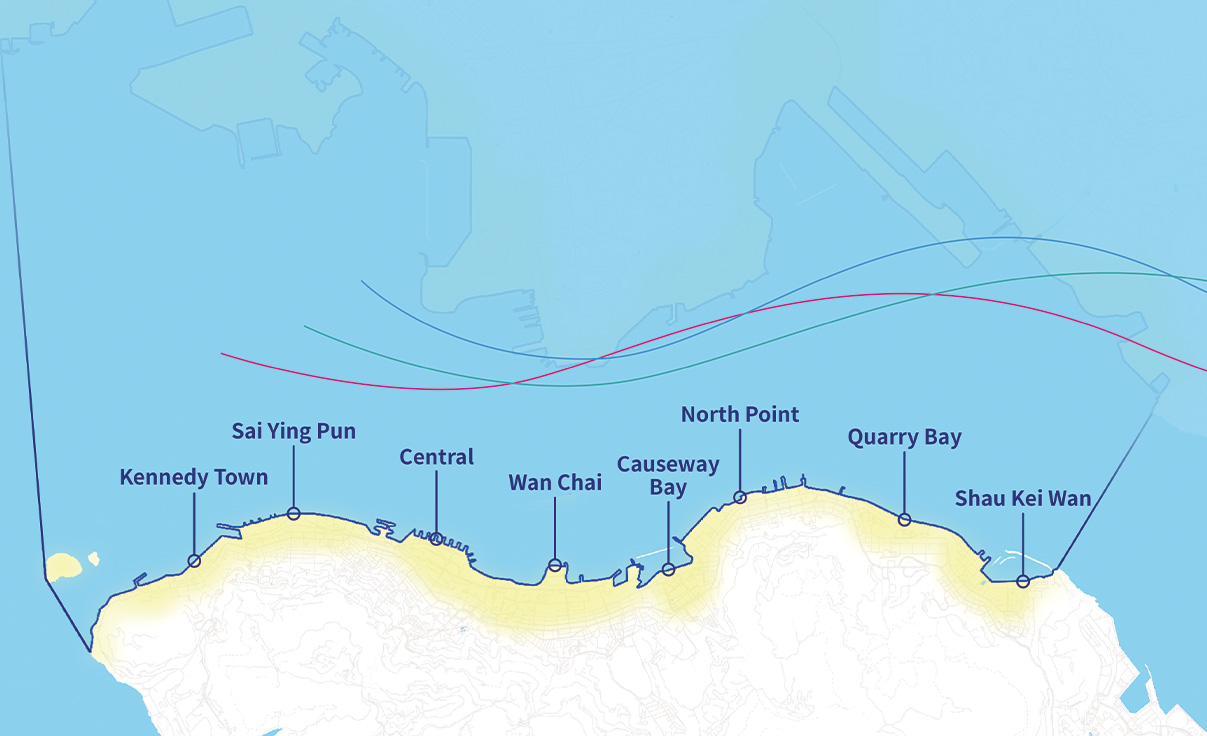
The East Coast Boardwalk underneath Island Eastern Corridor and connecting Fortress Hill and Quarry Bay is approximately 2.2 kilometres long and maintains a width of at least 10 metres wide throughout, with a western and an eastern section. The western section runs from Oil Street to Tong Shui Road, whereas the eastern section runs from Tin Chiu Street to Hoi Yu Street. The Boardwalk is designed to be a functional public space to accommodate both sedentary and physical activities along the boardwalk and adopts an overall concept of ”Citywave”, with eight thematic sections that reflect community characteristics. There will be six viewing platforms with water-friendly designs, a fishing platform, as well as other facilities such as landing steps, a pet garden, and an arts corridor along the Boardwalk. To share the vision of the harbourfront’s development, the Civil Engineering and Development Department established a Community Liaison Centre at the Tin Chiu Street waterfront in 2023, showcasing the transformation of the Eastern Harbourfront through multimedia exhibitions. The project is expected to be completed in phases between late 2024 and late 2025. Once fully open, the Island North Harbourfront Promenade will be seamlessly connected from Kennedy Town to Shau Kei Wan, with a total length of 13.2 kilometres.
Launching a Boardwalk over Water underneath Island Eastern Corridor
Civil Engineering and Development Department
Based on thorough discussion and public engagement results, the Civil Engineering and Development Department proposes an innovative engineering solution to build a boardwalk over water running through the space underneath the Island Eastern Corridor (IEC) to overcome the land constraint. The construction of the Boardwalk commenced in December 2021. Altogether, there are 72 spans of steel deck segments over the sea which are supported on the existing pile caps of the IEC and about 80 numbers of new marine piles.
Lying on the edge of Victoria Harbour, the project faced challenges due to the limited headroom of the IEC, which restricts the piling plant to be used and the length of pile segments for installation. Moreover, any chance of water contamination at the Victoria Harbour has to be prevented during the construction. With meticulous planning, the Contractor selected a new reverse circulation drilling method for the construction of the proposed pre-bored rock socketed H-piles, which secures the transportation of excavated debris to sedimentation tank through drill rods and pipes, avoiding water pollution issues in a better way than the conventional method. The project has also made use of pre-fabricated components to build the Boardwalk deck segments, including the structural steel frame and major architectural finishing works like glass balustrades.
To accomplish the completion targets in phases from end 2024 to end 2025, it is imperative to have a strong coordination throughout the tight construction timeframe. Upon commissioning, the Boardwalk will enrich the experience of different users, bringing vibrancy and livability enhancement.
Fun in Eastern District
Eastern District Office
The waterfront area in Shau Kei Wan has been popular with residents of the Eastern District for years. As announced in the Chief Executive’s 2013 Policy Address, the Signature Project Scheme was introduced to implement signature projects in all 18 districts across the territory. After extensive consultation involving local residents and major district organisations, the construction of a public open space near the waterfront in Shau Kei Wan was selected as the signature project for the Eastern District, i.e. the existing Eastern District Cultural Square (Cultural Square). This project would not only revitalise the waterfront area in Aldrich Bay, Shau Kei Wan and its surroundings, but also enhance the accessibility of the area near the Tam Kung Temple in Shau Kei Wan, thereby attracting more tourists and local residents to enjoy the beautiful waterfront scenery over there.
Situated at the junction of Tam Kung Temple Road, Tung Hei Road and Oi Lai Street, the Cultural Square was officially opened in March 2019. With an area of about 4 750 square metres, the Cultural Square can accommodate over 600 spectators, and has more than 2 000 square metres of greening space. The Cultural Square, equipped with a covered stage with ancillary equipment for outdoor performance, a piazza that can be doubled as spectator seating and a waterfront promenade connecting the adjacent Aldrich Bay Promenade, is a popular venue for cultural and recreation activities in the district. As regards its design, consideration was given to the traditional cultural ambience of Shau Kei Wan. In particular, the Eastern District Office (EDO), inspired by Cantonese opera for appeasing gods that take red as a symbol of auspiciousness, chose cinnabar red as the major colour for the stage to bring out different shades of red colour. In addition to creating a new harbourfront space for the Eastern District, the Cultural Square has enhanced the cultural atmosphere of the community and become the best place to relax and enjoy the scenery of Shau Kei Wan Typhoon Shelter. Since its opening, the EDO has worked with various district organisations to organise a number of activities/events at the Cultural Square, such as Movie Fun Show 2019, the Eastern District Flower Carpet Exhibition in Celebration of Hong Kong’s Return to the Motherland, signature programmes under the 2022-23 and 2023-24 Eastern District Cultural Festivals (i.e. the Chinese music sharing event, “Wandering around Eastern District” installation displays and the musical “Under the Roofs of Eastern District”), activities for the annual Tam Kung Festival, Christmas lighting decorations, and installations for the celebration of Hong Kong’s return to the motherland and National Day.
Looking ahead, the EDO will continue to work with district organisations to organise a wide variety of community activities, so as to make good use of the Cultural Square, a public space on the waterfront, making the Eastern District more special and vibrant.