Harbour's Talk:
Mrs Carrie LAM CHENG Yuet-ngor and HC Chairperson
Shaping a Unique World-Class Harbourfront through Good Governance
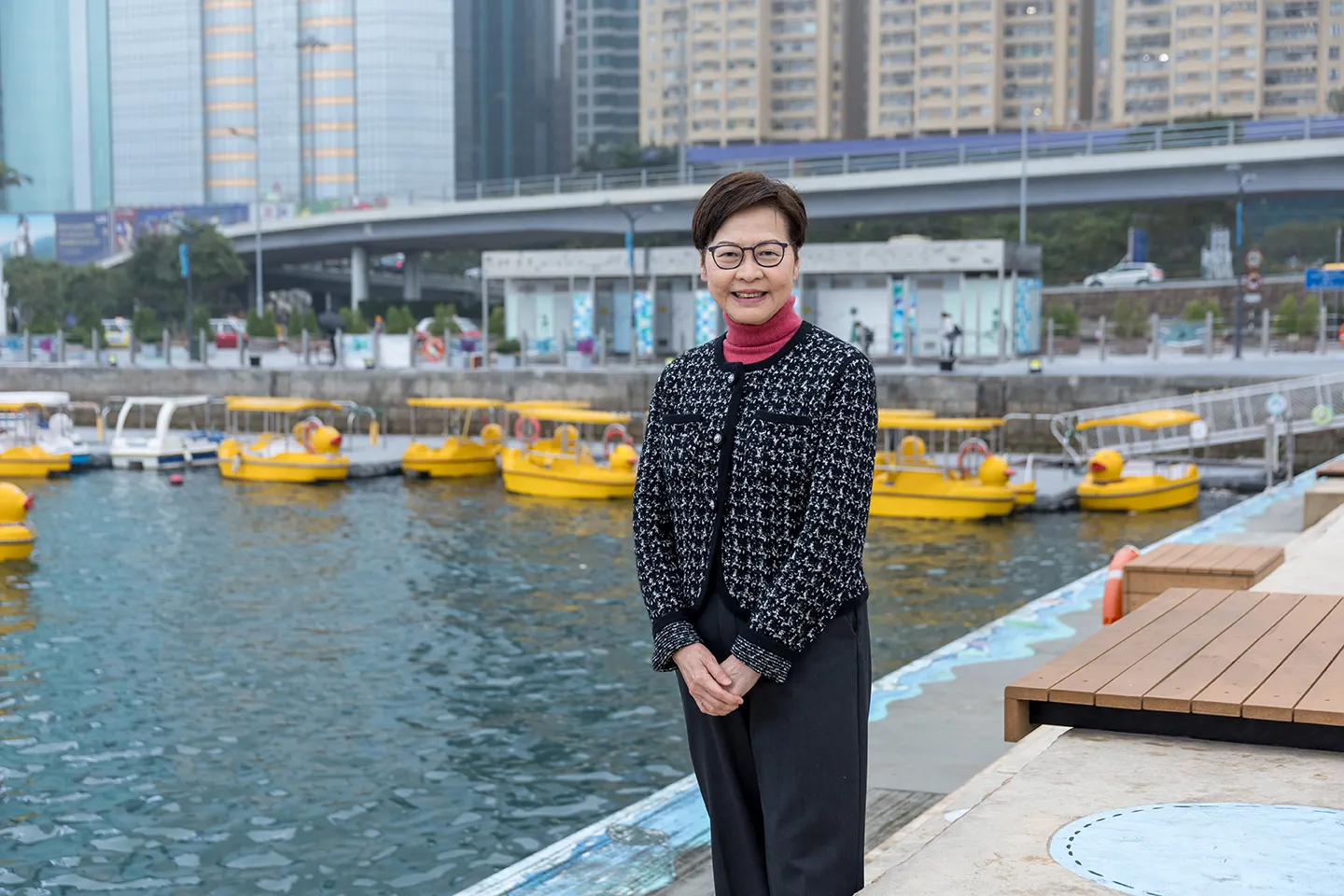
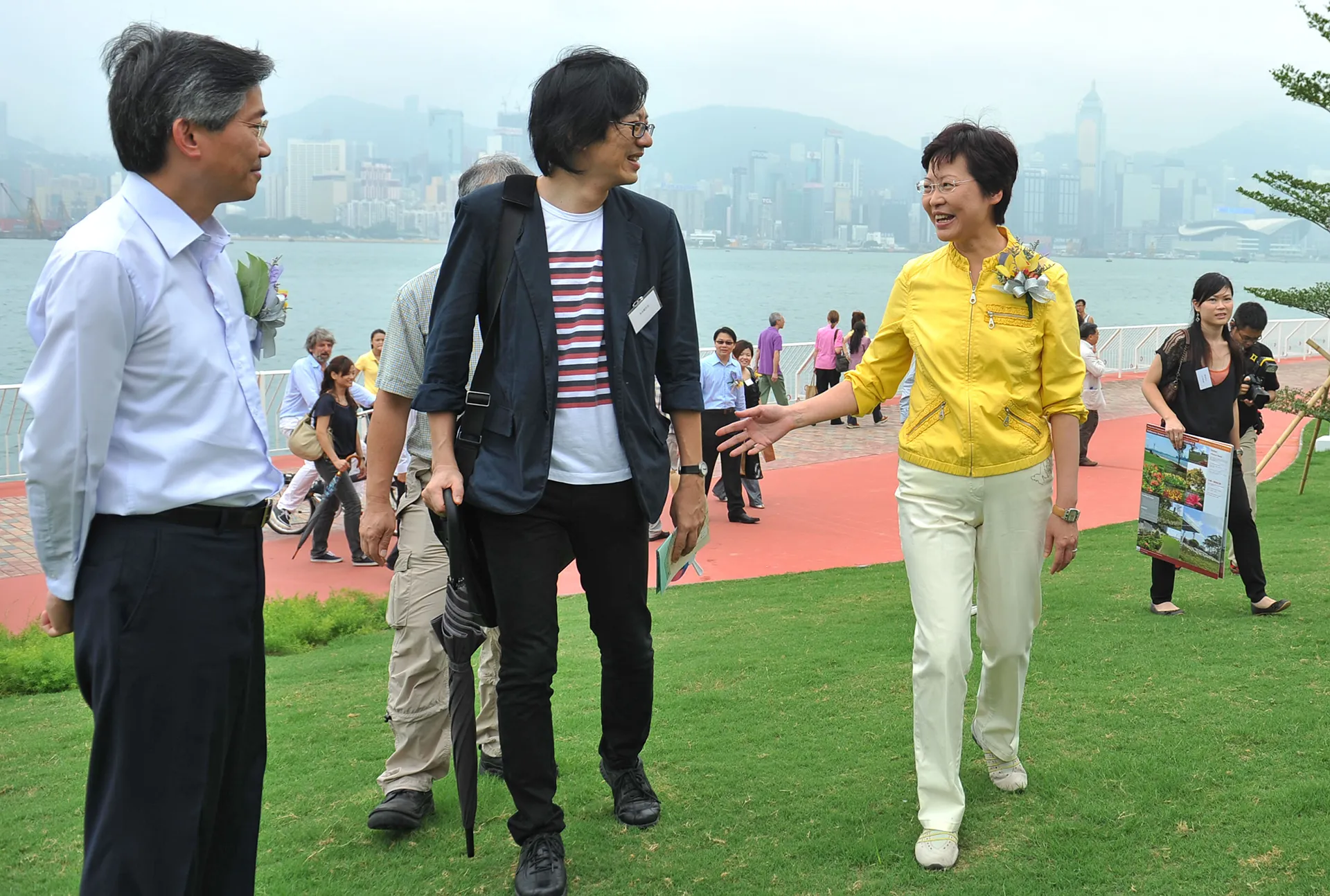
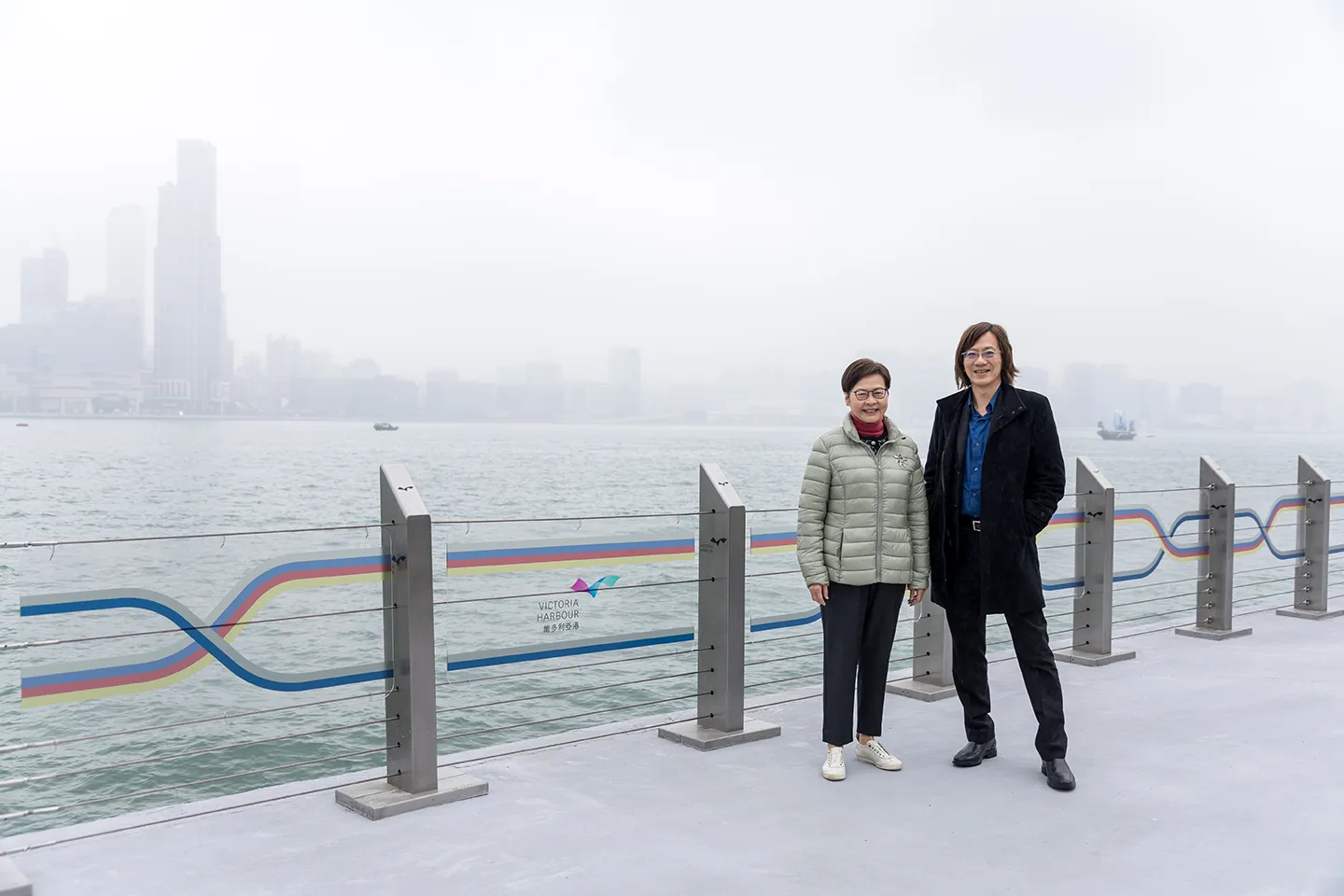
Reflecting on the 20-year journey of harbourfront development and envisioning, Mr Vincent NG Wing-shun, SBS, JP, Chairperson of the Harbourfront Commission (HC), interviewed three key leaders who had played a pivotal role in developing the Victoria harbourfront to hear about their experiences and insights. The first guest was Mrs Carrie LAM CHENG Yuet-ngor, GBM, GBS, JP, the then Chief Executive of the Hong Kong Special Administrative Region (HKSAR), who vigorously promoted and steered harbourfront development through government policy and governance efforts. Mrs LAM joined the Administrative Service of the Government in August 1980 and served in more than 20 policy bureaux and departments. She was promoted to the rank of Administrative Officer Staff Grade A1 in 2006, appointed the Secretary for Development in 2007 and the Chief Secretary for Administration in 2012, and was the Fifth-Term Chief Executive of the HKSAR from 2017 to 2022.
Mr Vincent NG
Mrs Carrie LAM
Law-based Public Governance Underlying Good Governance for Harbourfront Enhancement
The year 2024 marked the 20th anniversary of harbourfront development in Hong Kong. It is my hope to, through this commemorative publication, document the challenges and pathways to harbourfront development over the past two decades, and invite relevant key figures to share their experiences in this journey. In response to the controversy over the reclamation of the Victoria Harbour at the time, you introduced a consultative committee system to deal with matters related to the harbourfront, leading to the establishment of the former Harbour-front Enhancement Committee (HEC). What was your thinking behind that?
My work on harbourfront matters and the establishment of the former HEC was rooted in my philosophy of public governance. Earlier, I was invited to speak at the School of Public Policy and Management of Tsinghua University, where I summarised my 42 years of public service and explained how the HKSAR could achieve good governance under the principle of “One Country, Two Systems”. In discussing the element of “law-based administration with clear principles”, I cited the development of the Victoria Harbourfront as a case study, to which the audience listened with burning interest. First of all, good governance cannot be realised without adherence to the rule of law. When I was transferred to the Housing, Planning and Lands Bureau (the predecessor to the Development Bureau) as the Permanent Secretary for Planning and Lands in November 2003, my first key task was to deal with the judicial review litigation related to reclamation projects. Although reclamation for land creation had always been inextricably linked to Hong Kong’s development, given the enactment of the Protection of the Harbour Ordinance and the Court’s clear ruling, the Government must act according to the law, respect the ruling and strive to improve the work concerned, with the goal of actively responding to public aspirations, reducing disputes and reaching a consensus.
Moreover, good governance should not only be confined to mere compliance with the law, but also manifest the spirit of the law through administrative measures. The enactment of the Protection of the Harbour Ordinance and the series of social actions related to Victoria Harbour stemmed from the deep affection of the public for the harbour. The Government should actively respond to this sentiment, which was precisely the premise for establishing the former HEC. Through a broadly represented committee, the Government could be better advised on how to make collaborative efforts in the development of the Victoria Harbourfront.
So, why did the former HEC evolve into the current Harbourfront Commission in 2010?
I believe that promoting the beautification of the Victoria Harbourfront through community efforts would yield better results; therefore, the chairmanship of the former HEC had all along been taken up by a non-official individual. At that time, we aimed to ensure that the HEC could demonstrate broad participation and full inclusivity in every detail. For example, some members of the HEC were appointed based on nomination from stakeholders.
The transition from the former HEC, which was established after the conclusion of the litigation related to the harbour, to the HC was proposed by me after I took up the position of Secretary for Development in later years, mainly out of the consideration for an “upgraded” and “permanent” organisation. That said, its composition remained unchanged, with the chairperson still taken up by a non-official individual, while the responsible bureau chief served as vice-chairperson to ensure proper coordination and implementation by the Government. I am pleased to see that this characteristic remains intact to this day.
Exploring Harbourfront Management Models
Could you please tell us about the different focuses in harbourfront development over the past twenty years?
Initially, with the conclusion of the reclamation lawsuit, the Government announced its compliance with the Court’s ruling. Except for works related to the Central-Wan Chai Bypass project, no reclamations would be carried out in Victoria Harbour. The priority then was to build trust and foster unity among the public. Under the harmonious and pragmatic leadership style of its first chairperson, Professor LEE Chack-fan, the former HEC embarked on a number of public engagement activities, thereby achieving “co-creation” and receiving extensive support from stakeholders.
As the difference of opinions narrowed, the work related to Victoria Harbour entered the development stage. Among other things, consideration was given to public-private partnerships and injection of vibrancy into the harbourfront with a business mindset. Subsequent chairpersons, like Sr Nicholas Brooke (a professional surveyor) and your goodself (a professional architect), have successfully brought innovation, breakthroughs and new approaches to the work, creating a number of popular harbourfront promenades that have enhanced Hong Kong’s cityscape.
Looking back on the harbourfront development over the past twenty years, I believe the key to success is the passion of each and every chairperson or committee member and their “hands-on approach” to getting things done.
I recall discussions about establishing a dedicated statutory body, i.e. the Harbourfront Authority, to take forward harbourfront enhancement from planning, design and construction to operation and management under a one-stop approach, breaking free from the conventional management models and limitations the Government put in place at that time. It wasn't until your establishment of a dedicated harbour unit under the Development Bureau, which administered some new management models, that we could break from the inherent limitations and make new attempts in harbourfront development.
Establishing a statutory “commission” outside the government structure involves various considerations, including its business case, financial and staffing arrangements. In practice, we had to appreciate that harbourfront matters often involve various government departments and thus require effective inter-departmental coordination and overall planning on an ongoing basis. Taking account of this, during my tenure as Secretary for Development, I proposed instead to set up a dedicated unit within the Government to act as an advocate. It would take up the task and mission of beautifying Victoria Harbour. Should any questions arise in society about harbourfront matters, this unit would also take the initiative to consider how to provide appropriate responses. I was grateful that the Development Bureau and the departments under its purview embraced new attempts and that there was a slew of experienced and harbour-loving members under the Harbourfront Commission who tried out new models to develop and manage the harbourfront and such successful experiences were subsequently shared to other departments.
Indeed, one of the successful examples is the Wan Chai harbourfront, where we are meeting right now. Right after completing the works related to the Wan Chai Development Phase II project, the Civil Engineering and Development Department (CEDD) carried out simple installations on the site, and the venue could be opened in just a few months for public enjoyment. In fact, the CEDD could have followed the established procedures of returning the site to the Lands Department, followed by the design and works tendering conducted by the Architectural Services Department, before handing it over to the Leisure and Cultural Services Department for management as a final step. Now, as government departments such as the CEDD, the Drainage Services Department (DSD) and the Water Supplies Department were willing to take an extra step, the project completion time could be greatly shortened, marking a breakthrough in the development process.
In my view, all public bodies should move forward and respond positively to the aspirations of the community. Over the past decade or so, I have been glad to see noticeable changes in the Works Departments. For instance, greater emphasis is now placed on sustainable and environmental features and public spaces in engineering projects than in the past. In building a pumping station in Sheung Wan, the DSD took into full account the needs of the harbourfront promenade, while the CEDD converted the site office under the Tung Chung project into the Sustainable Lantau Office. These are all good examples. With public appreciation and recognition of their projects, the departments concerned would naturally be more motivated and have a stronger sense of mission to take a step further. If the CEDD could incorporate into the construction plans the details related to people’s livelihood, such as beautifying the environment and building cycle tracks, when rolling out large-scale projects, it would not only enhance project efficiency, but also enable the public to enjoy the facilities at an earlier time.
Public-Private Partnerships For Win-Win Outcomes
As harbourfront developments on both sides of Victoria Harbour become more sophisticated, which project do you particularly appreciate?
I would say it's the Avenue of Stars in Tsim Sha Tsui, which was built and is managed and maintained by a private developer. I consider it a good example of public-private partnership. In 2015, when I, as the Chief Secretary for Administration, oversaw the revitalisation works of the Avenue of Stars, the infrastructure of the Avenue was ageing. Just then a commercial redevelopment project was underway nearby. The developer was willing to invest in upgrading the entire area. Despite the highly politicised social environment in Hong Kong at the time, which sometimes made government officials hesitant about public-private partnerships, it turned out to be a win-win solution. I hope that the current more stable political environment can facilitate more mutually beneficial public-private partnerships in the overall public interest.
While we have made good progress in harbourfront development, public acceptance of public-private partnerships has also increased. The Avenue of Stars has shown how this public-private partnership approach can be a multi-win solution that benefits the public.
Under public-private partnerships, the Government may negotiate additional conditions with the developers as needed, leveraging the private sector’s market orientation and business acumen by allowing them to invest in and operate the sites, attend to daily management tasks such as cleaning, security and maintenance, and provide simple food and beverage services. All these can add value to the harbourfront and offer more convenient and diversified services to the public. As long as fundamental principle of openness, transparency and alignment with public interest are complied with, public-private partnerships can indeed inject more vibrancy into harbourfront development.
Fostering Mutual Understanding and Cooperation to Tell a Good Story of Victoria Harbour
Reflecting on the 20-year journey of developing the Victoria Harbourfront, how do you feel about the results?
At first, we aimed to enhance the accessibility of the harbourfront. Twenty years ago, many harbourfront areas were either inaccessible “public cargo working areas” or used for other government purposes, but after years of hard work and with the cooperation of relevant departments, we had progressively opened up a number of harbourfront areas for public enjoyment. Then, we wished to improve the connectivity of the harbourfront. At present, the connected harbourfront promenade has reached 27 kilometres and will be extended to 34 kilometres by 2028, leaving only several locations to be tackled. Looking ahead, I think our target should be to enrich the diversity of the harbourfront, so that each harbourfront section will have its unique characteristics. For instance, “Art@Victoria Harbour” in June 2022 was an exhibition showcasing the integration of art and innovative technology. The harbourfront work over the past twenty years deserves recognition. I believe this is a culmination of the collaborative efforts of successive chairpersons and members of the Commission.
What are your views and suggestions on the future development of the harbourfront?
The push for enhancing the harbourfront arose from controversies and tensions in the community. I hope we realised that we need to resolve conflicts with mutual understanding and accommodation, humbly learn from successful examples worldwide, and pay heed to constructive opinions. I believe that the people of Hong Kong are wise, and they will tell you what is good through their actions. The Belcher Bay Promenade is a notable example. Whenever the weather is good, parents will take their children there to play and relax, thereby creating a vibrant atmosphere. Although the pop-up or temporary facilities are subject to wear and tear, they can be maintained or replaced with new designs for children to explore and have fun. Through practice, innovative ideas that were stifled earlier by the fear of vandalism or visitors falling into the sea should have been unleashed, thereby leading to more breakthroughs in harbourfront development.
The enhanced connectivity of the harbourfront and the uniqueness of each harbourfront section have been well-received. In the past, when we dealt with harbourfront matters, we often had to find the lowest common standard, take the safest route, and balance the needs of various parties, only to get rather boring results. I would now say there is no one-size-fits-all formula for developing the Victoria Harbour. We need to experiment more in light of local characteristics and adorn each harbourfront section with special features. What do you think we should do to progress further towards a world-class waterfront?
Victoria Harbour is the “name card” of Hong Kong, but many local people and tourists may not be aware of its transition. I think Hong Kong may exchange views and share experiences with waterfront cities around the world more often. The harbourfront development work is an excellent story of Hong Kong from both political and management aspects.
Indeed, many people love Hong Kong and want it to do better; Hong Kong deserves to be better.
I hereby wish the Harbourfront Commission continued success in taking forward harbourfront development in Hong Kong.